
Our History & Strategic Plan
Explore the history of the University of Mississippi School of Law and the strategic priorities guiding its future.
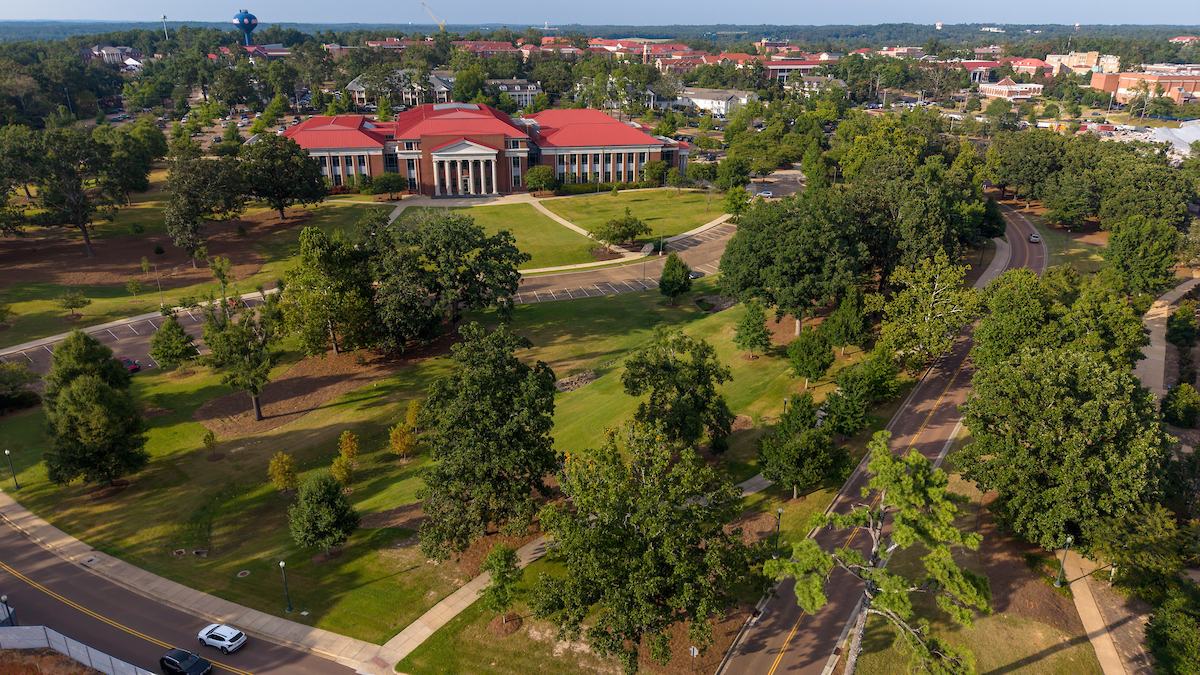
150+ Years of Legal Excellence
The first, seven-member law class of the University of Mississippi assembled in autumn of 1854 in a room in the Lyceum. By 1860, growing enrollment and a newly acquired law library purchased from the first law professor, William Forbes Stearns, meant that more space was needed. In June of that year, a building on the northwest corner of the Oxford Square (where the Merchants and Farmers Bank is now located) was rented from Oxford banker William P. Avent to house the law program. Fortunately, the law library apparently was moved back into the Lyceum when the university closed at the outbreak of the Civil War, and so it was not destroyed when the buildings in the Square were burned down by Union troops in August 1864. By 1866, the law program was up and going again in the Lyceum under professor L.Q.C. Lamar.
Lamar was devoted to his students and, in addition to giving lectures on texts and oral exams, Lamar had students summarize cases to discuss them in the next class. Some assert that he pioneered the use of case law as a method of study, also used by innovative dean of Harvard Law, Christopher C. Langdell, around the same time.
In 1887, Lamar became the first former university law professor to be appointed to the United States Supreme Court, where he served as an Associate Justice until his death in 1893. Lamar’s efforts to unify the U.S. post-Civil War were made the subject of a chapter in President John F. Kennedy’s book “Profiles in Courage.”
Although the program was suspended from 1872 to 1877 because of low enrollment, it was flourishing again by 1895. That year it was moved out of the Lyceum into the Old Northwest Dormitory, located near where Peabody Hall now stands, which it shared for the next 16 years with both the elocution program and the YMCA. The building, which had three floors, each with a balcony, was surrounded by tall shade trees and had been “nicely refurbished.” In 1897, Garvin D. Shands became the first law professor to receive the title of Dean of the Law Department. Thomas Somerville was then elected as dean in 1905, serving in that capacity until 1913.
By 1911, the law program had expanded to the extent that it needed a home of its own. That year, it moved into the neo-Gothic building, known today as Ventress Hall. That building had been erected 20 years earlier by the first law professor to become chancellor of the university, Edward Mayes. Serving as the university’s library, it was no longer large enough to continue in that capacity. In this new law school building, Leonard J. Farley served as dean from 1913 to 1921. He was assisted by one law professor and a number of local lawyers who came in from outside to teach. In 1922, the law school was accredited by the Association of American Law Schools (AALS) and, in 1928, the first volume of the Mississippi Law Journal was published.
By the late 1920s, Ventress Hall had become too small to accommodate both the growing number of law students and the ever-expanding law library. In 1930, however, the school had already moved into a newly built home over on the other side of the Grove, which was named Lamar Hall but was generally referred to as “the law building.” Built as a law school, this building had offices for instructors, ample classroom facilities and a moot court room. During the deanship of Robert J. Farley (1946-63), the building was expanded in size, and it is known today as Farley Hall.
In 1963, Joshua Morse III became Dean of the law school. He hired as law professors a talented group of young Yale law school graduates who along with the students provided legal assistance to the poor.
Also in 1963, the second African American student admitted to the university, Cleve McDowell, was approved for admission to the law school. He was roommates with James Meredith, who integrated the university in 1962. After Meredith graduated, the federal troops that had protected him for the last year were no longer on campus. McDowell requested permission to carry a firearm and was denied. He asked for better protection, but continued to carry a small handgun. As he was running up the steps of Lamar Hall late for class, he dropped his sunglasses. When he bent over to pick them up, the gun fell out of his pocket. He was arrested and expelled for unlawful possession of a firearm.
By the fall of 1966, fourteen African American students were enrolled at the university including Reuben V. Anderson, who became the law school’s first black graduate in 1967. Constance Slaughter Harvey became the first African American female graduate of the law school in 1970. During her time at the university, she founded the chapter of the Black Law Students Association. She also served as the only woman on BLSA’s inaugural National Board of Directors.
Under Dean Morse’s leadership the law school became a focal point for social change. He fought against discrimination and racism, and students were exposed to a more expansive view of the nation and world. Dean Morse left the law school in 1969 to become Dean of the Florida State University law school.
In 1978, the by-then greatly expanded law school, now known as the Law Center, moved into a new building eastward across the parking lot from Farley Hall. This Bauhaus-style building, which represented a departure from the red brick and columns of the Greek revival style in which most of the buildings on campus had been built, became known as the Lamar Law Center. Eventually housing the law school, the Eastland Law Library, the National Center for Remote Sensing, Air and Space Law, the National Center for Justice and the Rule of Law, the Mississippi Judicial College and the American Academy of Judicial Education, the center was the law program’s home from 1978 to 2010.
In January 2011, the law program moved into a new home named for Robert C. Khayat, a law professor who had served as chancellor of the university from 1995 to 2009. A LEED-certified building located on the south end of the campus and designed with students’ needs in mind, its architecture blends in well with the beauty of the Ole Miss campus. The University of Mississippi School of Law remains Mississippi’s only state-supported law school.
Throughout the Law School’s history, it has remained constant in its desire to provide the best possible legal education for its students and is committed to equal justice for all.
Our 2030 Strategic Plan
The Law School Strategic Planning Steering Committee has conducted listening sessions with faculty, staff, students, and alumni to develop the new 2030 Strategic Plan. The first phase of the strategic planning process has been completed with the adoption of the School of Law’s Strategic Priorities.
The School of Law will share additional details of the 2030 Strategic Plan once the review process and updates are finalized.
The Law School graduates innovative, practice-ready lawyers who enhance the legal profession, promote the cause of justice, and serve the public. The Law School empowers students to reach their highest potential through a curriculum centered on doctrinal courses, legal research and writing, skills training, clinical instruction, externships, and professional ethics. As a state school, the Law School has a special commitment to educate state residents and train lawyers who will serve the needs of the State of Mississippi.
The Law School advances legal knowledge through the publication and presentation of original scholarly research. The Law School’s support for scholarship and a vibrant culture of inquiry provides a crucial foundation for the teaching and service components of the Law School’s mission—in addition to the intrinsic value of the expansion of knowledge.
The Law School serves diverse communities through its programs and personnel in order to transform lives and promote access to justice, legal professionalism, progress, reform, and the public interest. The Law School’s clinics, centers, institutes, and programs are essential to the Law School’s service mission, which has a special emphasis on Mississippi communities.
As an outstanding public law school, the University of Mississippi School of Law leads, excels, and inspires by preparing students for the practice of law in a changing global marketplace, expanding the horizons of legal knowledge through scholarly research, and serving diverse communities in the state, region, nation, and world. As it pursues its mission, the Law School also has a special responsibility to the State of Mississippi as the State’s only public law school and a central component of its flagship university. The Law School is committed to creating and nurturing an academic environment where all people are welcome, all voices are heard, and where together, we undertake the serious pursuit of knowledge and growth. This strategic plan offers a roadmap to achieving those goals.
1. Admissions & Student Recruitment
We recognize that our students are future lawyers and leaders, who will shape policy and bring a commitment to justice at the local, national, and global levels. The Law School is committed to recruiting a student body that is both academically strong and diverse. Moreover, as a state institution, the Law School has a particular responsibility to educate residents who will serve the State of Mississippi. The Law School is also committed to growing the number of law students who are the first in their family to graduate college as well as ensuring that our student population is made up of students from diverse socioeconomic backgrounds. Our goal is to increase the number, quality, and diversity of applicants to the Law School, with particular emphasis on Mississippi residents.
2. Student Employment & Bar Passage
We recognize that student employment and bar passage are foundational to the Law School’s mission as a professional school. The Law School is dedicated to ensuring that students pass the bar and obtain rewarding employment. In particular, we are committed to securing employment opportunities for our students in a wide variety of settings, including private law firms, public interest organizations, government, and business, and in all locations—within the State of Mississippi, across the nation, and beyond. We are committed to increasing our bar passage rate and striving towards even greater success in our student employment numbers. In addition to employment and bar passage rate, the Law School will work to help students interested in pursuing further graduate studies after law school with graduate program placement.
3. Academic Excellence
The Law School is committed to a “students-first” philosophy of education and empowerment. Our goal is to prepare students for the practice of law and enable them to compete in a changing global marketplace. Towards that end, we aim to ensure that every student cultivates the right path to achieve their vision of success. We intend for our graduates to enhance the legal profession, promote justice, and serve the public. To support student learning, the Law School is dedicated to a rigorous curriculum built around doctrinal courses, legal research and writing, skills training, clinical instruction, externships, and professional ethics. We are also committed to providing a strong academic success program to ensure that all students are given the tools necessary to achieve the academic excellence that marks our institution.
It is not only our curricular offerings that make us academically excellent. We are also committed to supporting the academic pursuits of faculty and staff that enhance the academic excellence of our community, whether it is the pursuit of advanced degrees, engagement with the broader community in further learning opportunities, or the development of innovative pedagogical approaches.
4. Access, Opportunity & Engagement
The University of Mississippi School of Law is committed to creating an educational experience that affirms equal opportunity and an inclusive community for all regardless of race, color, ethnicity, gender, sex, sexual orientation, gender identity or expression, religion, national origin, age, disability, military status, protected veteran status or genetic information. This is not only required by law, but is consistent with our deep commitment to the University’s core values and overall philosophy as reflected in the UM Creed. We are committed to welcoming students who are the first generation in their family to graduate college, as well as students from different socioeconomic backgrounds. We welcome the contributions of a diverse student body, faculty, and staff, whose perspectives and different backgrounds, and experiences help create a more inclusive community for everyone.
Exposure to a diverse community of people from different backgrounds and experiences allows students to strengthen their critical thinking, legal reasoning, and creative problem-solving skills. These competencies are essential to a quality legal education and allow our graduates to become better attorneys. To create the inclusive and diverse community of students, faculty, staff, and administration necessary for the success of our institution, we are committed to pursuing initiatives to build greater community engagement.
5. Research & Intellectual Life
We recognize that legal scholarship is of crucial importance because it expands the horizons of legal knowledge and is integral to the Law School’s teaching and service missions. We are therefore committed to the publication and presentation of scholarly research and to the development and support of research and intellectual efforts. To promote this end, the Law School seeks to foster a culture of scholarship and intellectual inquiry not only amongst our faculty but also with respect to our students and staff.
6. Alumni Relations & Development
We view our alumni as family, and we know that they immeasurably benefit our students and add tremendously to the life of the Law School. We are therefore committed to renewing a greater sense of community with our alumni and reinvigorating a culture of giving. In particular, the Law School acknowledges the importance of private financial support for our students and our programs as student debt increases and state funding diminishes. New scholarships for our students are of special importance. We also recognize the crucial role alumni play in the recruitment and placement of students and the immense value their mentorship provides. Our alumni are uniquely positioned to support and guide our law students through their law school journeys and beyond. To this end, we will work towards expanding initiatives that create opportunities for alumni outreach and development.
7. Service & Community Engagement
We recognize that the Law School’s service to a diverse range of communities transforms lives and makes the world a better place. In particular, the Law School’s clinics, centers, institutes, and student organizations are essential to the success of the Law School’s service mission, which has a special emphasis on Mississippi communities. Through community engagement, our programs and personnel use their professional expertise to advance the public interest and promote reform, progress, professionalism, and access to justice.
Community engagement does not only mean engagement with external communities but with our internal Law School community as well. We strive to create a welcoming community for all members of our Law School: students, staff, faculty, and administration, and in pursuit of that goal are committed to developing initiatives that will enhance well-being and contribute to fostering joy and positivity.
I believe in respect for the dignity of each person.
I believe in fairness and civility.
I believe in personal and professional integrity.
I believe in academic honesty.
I believe in academic freedom.
I believe in good stewardship of our resources.
I pledge to uphold these values and encourage others to follow my example.